

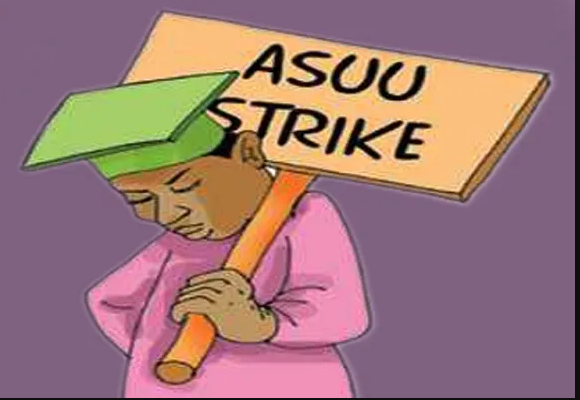
The Academic Staff Union of Universities (ASUU) has declared a two-week warning strike, beginning today, Monday, October 13, 2025, following the expiration of its 14-day ultimatum to the Federal Government.
The announcement was made on Sunday by ASUU’s National President, Prof. Chris Piwuna, during a press briefing at the University of Abuja. The decision comes after negotiations between the union and the government collapsed despite ongoing efforts to avert industrial action.
“Compatriots of the press, it goes without saying that there is nothing sufficient on the ground to stop the implementation of the ASUU-NEC’s resolution to embark on a two-week warning strike at the expiry of the 14-day notice given on the 28th September 2025,” Piwuna stated.
He directed all ASUU branches nationwide to withdraw their services effective midnight, stressing that the warning strike would be “total and comprehensive,” as agreed at the union’s last National Executive Council (NEC) meeting.
The strike declaration follows the rejection of a new government proposal presented to ASUU last Friday, which the union described as “a total departure” from the reviewed draft agreement earlier submitted by the Yayale Ahmed committee.
According to Piwuna, the document failed to address key issues such as the renegotiation of the 2009 FGN-ASUU agreement, withheld salaries, revitalisation funds for universities, and outstanding allowances. He described the proposal as “provocative and incapable of dousing industrial tensions,” accusing the government of raising false hopes and showing disregard for prior commitments.
ASUU’s demands include the release of three and a half months’ withheld salaries, payment of 25–35% outstanding salary arrears, revitalisation funds, promotion arrears, third-party deductions, and an end to the victimisation of lecturers at certain universities.
Meanwhile, the Federal Government has appealed to ASUU to reconsider its decision, warning that it may enforce the “no work, no pay” policy if the strike proceeds.
In a joint statement signed by the Minister of Education, Dr. Tunji Alausa, and the Minister of State for Education, Prof. Suwaiba Ahmad, the government emphasised that dialogue remains the most sustainable path to resolving disputes in the tertiary education sector.
The statement, issued through the ministry’s spokesperson, Folasade Boriowo, claimed that the government had made “a comprehensive offer” addressing ASUU’s major concerns, including welfare, governance, and working conditions.
“The ministers further stressed that the government has continued to prioritise the welfare of university staff and the stability of the academic calendar under the Renewed Hope Agenda of President Bola Ahmed Tinubu. However, the ‘no work, no pay’ policy remains an extant labour law, and the government will be guided by it should academic activities be disrupted,” the statement read.
The government reassured students and parents of its commitment to maintaining stability in the education sector, urging academic unions to embrace dialogue rather than confrontation.
Reacting to the development, the National Association of Nigerian Students (NANS) expressed concern over the renewed strike, urging both parties to act swiftly to prevent further disruption of the academic calendar.
NANS Assistant General Secretary, Adejuwon Emmanuel, said the student body was deeply worried about the potential impact on students nationwide. “We have endured too many disruptions. Another strike will only worsen our hardship,” he said, adding that NANS President Olushola Oladoja had initiated consultations to mediate between ASUU and the Federal Government.
While acknowledging ASUU’s legitimate grievances, NANS appealed to the union to explore alternative methods of engagement, urging the government to demonstrate sincerity and urgency in fulfilling its promises.
In a related development, the Academic Staff Union of Polytechnics (ASUP) has given the Federal Government a six-week deadline to meet its demands, noting that it had observed some progress following structured engagements with the Education Ministry.
The union commended the government’s recent actions, including the release of circulars on allowances, renewed needs assessment funding, and reconstitution of renegotiation committees but warned that its patience was not limitless.
As the ASUU strike begins, tension mounts across public universities, with students, parents, and administrators anxiously awaiting a resolution to yet another chapter in Nigeria’s long-running university funding crisis.