

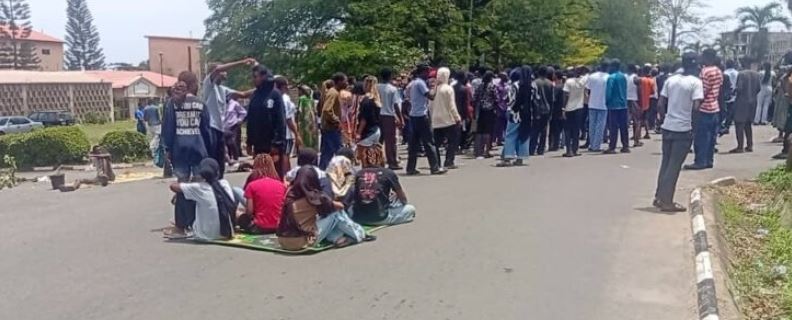
Students of the University of Ibadan on Wednesday disrupted academic activities in protest against prolonged electricity and water outages that have made living and learning conditions increasingly difficult on campus.
The protest, which began at Independence Hall and Nnamdi Azikiwe Hall, quickly spread across faculties as students mobilised to express frustration over the lack of basic amenities. Demonstrators also blocked movement along Oduduwa Road, a major route linking key parts of the university.
The situation follows the ongoing industrial action by the Non-Academic Staff Union of Universities and the Senior Staff Association of Nigerian Universities, which has severely disrupted essential services on campus, including electricity supply and water distribution.
Students say the conditions have become unbearable, with many unable to bathe, cook, or study effectively. A final-year Law student who spoke anonymously described the protest as long overdue, lamenting that students had endured four days without electricity or water while still being expected to attend lectures.
Another student, who identified himself as Jasper from the Faculty of Pharmacy, clarified that the protest was not directed at the striking workers but at the broader situation. He argued that it was unreasonable for academic activities to continue when the environment no longer supports basic human needs, calling on lecturers to show solidarity by suspending classes.
In a statement signed by Students’ Union leaders Temidayo Adeboye and Joshua Shontan, the union declared that the ongoing strike has led to a complete breakdown of living conditions on campus. The closure of the University Health Centre, widely known as Jaja Clinic, alongside the blackout and water shortage, has further worsened the situation.
The union announced an indefinite suspension of all academic activities, insisting that meaningful learning cannot take place under such harsh conditions.
University management, however, has pushed back against the protest. The institution’s spokesperson, Adejoke Akinpelu, questioned the basis of the agitation, stating that the outages were a direct consequence of the ongoing strike. She explained that without electricity, water supply systems cannot function, and noted that the strike has also prevented lecturers from accessing offices and lecture halls.
She added that the management has taken steps to ease the situation, including providing generator-powered electricity to hostels for limited hours. According to her, two generators consumed about 1,600 litres of fuel in just two hours to supply temporary relief.
The unrest comes amid a broader national dispute, as NASU and SSANU continue negotiations with the Federal Government over the delayed renegotiation of the 2009 agreement covering salaries and working conditions. Although the unions have announced plans to suspend the strike effective May 11, the impact of the industrial action continues to ripple across campuses.
For many students at the University of Ibadan, the protest is not just about power and water—it is a demand for dignity, fairness, and a learning environment that meets the most basic standards.