

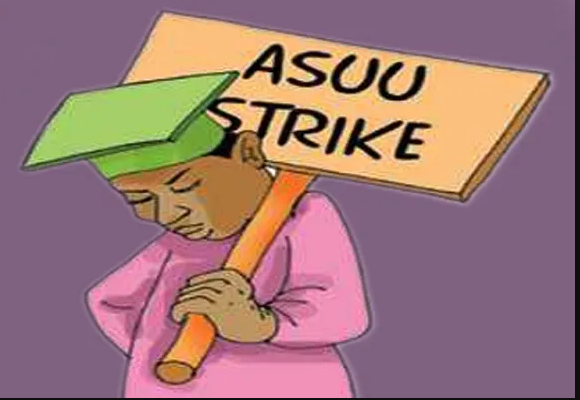
The Deputy Spokesperson of the House of Representatives, Hon. Philip Agbese, has cautioned the Nigeria Labour Congress (NLC) against joining the ongoing strike by the Academic Staff Union of Universities (ASUU), warning that such a move could derail the education sector reforms being implemented by the Minister of Education, Dr. Maruf Tunji Alausa.
Agbese made the appeal while addressing journalists at the National Assembly after Wednesday’s plenary session, following NLC’s four-week ultimatum to the federal government to resolve all pending issues with tertiary institution-based unions or face a nationwide solidarity action.
The NLC President, Comrade Joe Ajaero, had on Monday threatened that the union would take drastic measures if the government failed to conclude negotiations within the stipulated time.
But Agbese urged the NLC, ASUU, and other education stakeholders to exercise restraint and allow the ongoing reforms to take root, describing the current initiatives under the Education Minister as “bold, far-reaching, and targeted at repositioning Nigeria’s educational system for global competitiveness.”
“In developed countries, when a government begins to perform well in certain sectors, citizens usually give it some time—a sort of holiday—to consolidate on progress made. That is what we need to do now for our education sector,” he said.
According to the lawmaker, several positive steps have been taken by Dr. Alausa to tackle long-standing challenges in tertiary education, including reforms in university administration, improved funding transparency, and renewed emphasis on research, innovation, and digital learning.
Agbese noted that the government had raised annual admission capacity in tertiary institutions from 750,000 to one million students, harmonised tuition policies through the Nigeria Education Loan Fund (NELFUND) to ensure fairness, and launched the Nigeria Education Sector Renewal Initiative (NESRI) Roadmap to drive transformation in the sector.
He also highlighted the Students Loans initiative under NELFUND, which now enables indigent students to access higher education, and the World Bank-supported Adolescent Girls Initiative for Learning and Empowerment (AGILE) project, which provides cash transfers, improves school facilities, and equips girls with life and digital skills.
“These initiatives are beginning to yield visible results and should be nurtured, not truncated by another round of industrial action,” he said, adding that strikes have historically worsened the plight of students, particularly those from poor backgrounds.
Agbese urged ASUU to “evolve beyond the same old formula that has crippled our academic calendar for years” and instead act as a think tank that offers constructive policy solutions.
“The worst hit each time ASUU goes on strike are the poor teachers’ children and those from low-income homes who attend public universities,” he lamented.
Reaffirming the National Assembly’s commitment to act as a bridge between the government and education stakeholders, Agbese assured that the legislature remains open to dialogue and intervention where necessary.
“Our doors are open. Let’s work together to strengthen the system instead of shutting it down,” he concluded.