

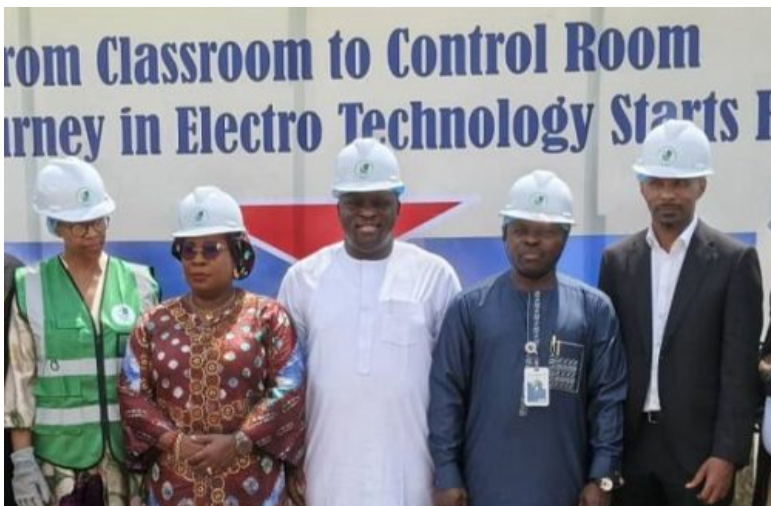
Nigeria’s push for homegrown technical talent received major momentum at the weekend as Momas Group laid the foundation for a €3 million Momas Technical Vocational and Educational Training (TVET) Centre for Electro-Technology in Ogun State. The landmark project—funded by the African Union in partnership with AUDA-NEPAD and the Skills Initiative for Africa (SIFA)—is set to become one of the country’s most advanced hubs for vocational training in the power and renewable energy sectors.
Momas secured the AU-backed grant under SIFA’s Funding Window 1, designated for large-scale skills development initiatives. At the groundbreaking ceremony, Senior Special Assistant to the President on Industrial Training and Development, Adamson Ayinde, hailed the centre as a model for private-sector leadership in solving Nigeria’s critical manpower shortages.
Ayinde noted that the facility directly addresses deficits in smart electricity metering, electrical wiring and maintenance, renewable energy technologies and electro-technology safety. He praised Momas for its “patriotism, foresight and commitment to national development,” noting that the company exceeded the required 10 percent counterpart funding. According to him, the project aligns with the Federal Government’s drive to develop a technologically competent workforce and reduce dependence on foreign artisans.
“This centre is a promise to our youths—an opportunity, an empowerment platform and a pathway to meaningful employment and entrepreneurship,” Ayinde said. “Today marks a major milestone in Nigeria’s journey toward building a globally competitive workforce.”
AUDA-NEPAD representative, Gemechu Kusa, described the centre as a transformative training ground that will equip young Africans with life-changing technical skills, particularly in renewable energy and electro-technology. He emphasised that the institution’s focus on solar photovoltaic systems will enable it to tackle youth unemployment while supporting Nigeria’s energy transition.
“Technical and vocational education is not a second choice,” Kusa said. “It is a first-class pathway to dignity, opportunity and sustainable livelihoods.”
President of the Nigerian Society of Engineers (NSE), Margaret Oguntala, applauded Momas for what she called a timely and visionary project. She stressed the urgency of building local technical capacity to drive Nigeria’s infrastructure and industrial growth, urging strong collaboration from government and industry stakeholders to maximise the centre’s impact.
Chairman of Momas Group, Engr. Kola Balogun, said the centre will build on years of investment in youth empowerment by providing practical skills that lift young Nigerians out of poverty while strengthening the nation’s industrial base. He revealed that support from NEPAD and the German government will enable the acquisition of cutting-edge equipment and expansion of training programmes—creating pathways that could allow graduates to work in Europe and other parts of the world.
Balogun emphasised the centre’s crucial role in advancing Nigeria’s renewable energy ambitions. “We will provide the skills needed to install solar panels, solar batteries and energy storage systems, complementing the government’s massive investments in renewable energy,” he said. Construction of the centre is expected to be completed within one year, with NEPAD directly funding the contractor.
Group Managing Director of Momas, Hammed Abiodun, described the groundbreaking as a major milestone reflecting the company’s long-standing commitment to youth development. He noted that global trends show skill acquisition is the future, citing China as an example of how a nation can rise by empowering its young population.
“Our goal is to harness Nigeria’s large youth population by training and reshaping them to contribute meaningfully to national development,” Abiodun said.
With its advanced equipment, international partnerships and focus on cutting-edge energy technologies, the upcoming Momas TVET Centre is poised to become a flagship institution—shaping a new generation of Nigerian technicians and engineers ready to compete on the global stage.