

Nigeria’s drive to compete in the global digital economy is facing renewed attention as the Tertiary Education Trust Fund (TETFund) advances plans to establish Centres of Excellence in Robotics, Coding, Artificial Intelligence (AI), Machine Learning, and Cybersecurity across selected public universities.
The initiative is being described as a strategic shift from theory-based learning to hands-on innovation, aimed at strengthening the country’s weak digital skills pipeline and positioning universities as engines of technological development and startup creation.
For years, experts have warned that Nigeria’s ambition in the tech space has been constrained less by lack of talent and more by insufficient infrastructure. Although the country produces about 2,500 AI graduates annually and has an estimated 50,000 AI workers, this remains far below the demand required to sustain its fast-growing digital ecosystem.
Current data also shows that only 31 per cent of African universities offer dedicated AI programmes, while just 34 per cent run data science degrees, highlighting a continental gap in advanced digital training that Nigeria is now attempting to address through the proposed centres.
The absence of specialised facilities has also limited the emergence of research-driven startups from universities, unlike in advanced economies where academic institutions serve as launchpads for breakthrough innovations. Despite Nigeria hosting over 430 fintech companies and 3,000 tech startups, many still rely heavily on imported technologies and foreign expertise.
The development comes at a time when Nigeria ranks 103rd out of 127 countries in the 2025 Network Readiness Index, underscoring persistent challenges in digital infrastructure, innovation capacity, and research output.
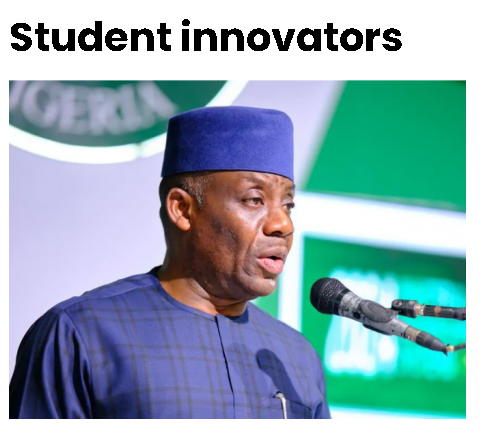
Speaking at the inauguration of the TETFund Advisory Committee on Robotics, AI, Machine Learning, Coding and Cybersecurity Centres, Executive Secretary of TETFund, Sonny Echono, said the initiative is aimed at strengthening national security, closing skills gaps, and preparing young Nigerians for global competitiveness.
He explained that the Federal Government had approved the establishment of at least six Centres of Excellence to be hosted in public universities across the six geopolitical zones, ensuring national balance and inclusiveness in implementation.
According to him, the newly constituted committee—chaired by former Secretary-General of the Committee of Vice Chancellors of Nigerian Universities, Prof. Yakubu Ochefu—is tasked with identifying suitable institutions based on merit, capacity, and proven strengths in relevant technological fields.
Echono added that the centres would be equipped with modern infrastructure to support advanced research and practical training, enabling students and researchers to develop innovative solutions tailored to Nigeria’s developmental needs.
In his response, Prof. Ochefu pledged that the committee would adopt transparent and merit-based criteria in selecting beneficiary institutions, noting that countries that have succeeded in the digital economy invested deliberately in research-driven innovation hubs.
He emphasized that the centres would not only strengthen academic research but also serve as incubation platforms where ideas can be transformed into viable commercial technologies and startups through collaboration between academia and industry.
Experts believe the initiative could mark a turning point in Nigeria’s digital transformation journey by improving access to advanced training, boosting research output, and accelerating the development of indigenous technology solutions.
As artificial intelligence, robotics, machine learning, and cybersecurity continue to reshape global economies, stakeholders argue that Nigeria’s long-term competitiveness will depend on its ability to invest in human capital, research infrastructure, and innovation-driven education systems.
The planned Centres of Excellence are therefore seen as a critical step toward repositioning universities as the foundation of Nigeria’s future digital economy and innovation ecosystem.