

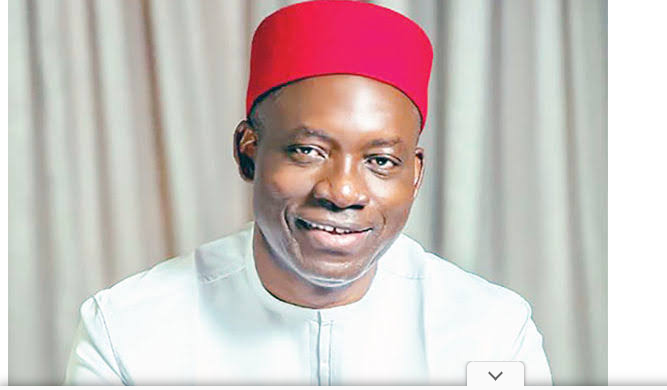
Governor Chukwuma Charles Soludo of the All Progressives Grand Alliance (APGA) has secured a sweeping second-term victory in the November 8, 2025, Anambra State governorship election, winning all 21 local government areas in a result described by observers as one of the most emphatic mandates in the state’s political history.
The Independent National Electoral Commission (INEC) declared Soludo the winner on Sunday at its collation centre in Awka, where the Returning Officer, Prof. Edoba Omoregie, announced that the APGA candidate polled 422,664 votes to defeat his closest rival, Nicholas Ukachukwu of the All Progressives Congress (APC), who garnered 99,445 votes. Other candidates, including Labour Party’s Dr. George Moghalu and the African Democratic Congress (ADC)’s John Nwosu, trailed with far lower tallies.
Out of 2,788,864 registered voters, only 598,229 were accredited. INEC recorded 584,054 valid votes and 11,244 rejected ballots. Elections were cancelled in parts of Anambra West, Anaocha, Awka South and Onitsha South due to disruptions, affecting 10,481 votes—insufficient to alter the outcome.
“In view of the results and having satisfied the requirements of the law, I, Prof. Edoba Omoregie, hereby declare Chukwuma Soludo of the All Progressives Grand Alliance elected governor of Anambra State,” Omoregie said.
For APGA, the victory reinforces its near two-decade dominance in Anambra politics, while for Soludo, it marks a transition from technocratic reformer to entrenched political leader with control over the state’s complex power structure.
Analysts attribute Soludo’s clean sweep to a blend of zoning dynamics, elite alliances, and APGA’s enduring grassroots reach. The unwritten zoning arrangement that has rotated the governorship among the state’s three senatorial zones—North, Central, and South—since 2006, played a defining role.
Soludo, from Anambra South, was widely seen as completing his zone’s two-term slot before the governorship rotates back to Anambra Central in 2029. This logic attracted the quiet backing of influential figures from the Central zone who viewed Soludo’s re-election as the most strategic route to reclaiming power in the next cycle.
“The calculation was simple,” said political analyst Chidi Nwafor in Awka. “Let Soludo finish the South’s turn, and the Central takes over in 2029. It was not sentiment—it was political arithmetic.”
While opposition candidates—Ukachukwu, Moghalu and Nwosu—also hailed from the South, their candidacies only reinforced the perception of continuity in zoning rather than creating a viable alternative.
Meanwhile, APGA’s deep-seated structures, built over nearly 20 years of continuous governance, gave the party a formidable edge. With local coordinators, market leaders, youth groups and religious networks mobilizing across wards and communities, the party’s organization proved far superior to its rivals.
The election recorded a turnout of about 21 percent—modest, but slightly higher than recent polls. Many voters cited economic strain and disillusionment with politics as reasons for staying away.
Labour Party entered the contest divided by leadership disputes, weakening its ability to convert the momentum it enjoyed in the 2023 general elections. The APC, despite federal backing, struggled with its perception as an “outsider” party in Anambra. Ukachukwu’s campaign gained some traction in Nnewi South and Ihiala, but not enough to challenge APGA’s dominance.
Other smaller parties like ADC and YPP fielded notable candidates but lacked the statewide networks necessary for serious contention.
Soludo’s first term combined ambitious infrastructure drives with controversy. His administration built or rehabilitated over 400 kilometres of roads, expanded basic education funding, revamped waste management and began urban renewal in Awka and Onitsha.
However, his confrontational style and enforcement policies drew criticism from transport unions, traders and church leaders. Yet, for many rural communities, the tangible impact of new roads and schools outweighed grievances, helping deliver overwhelming grassroots support.
In his victory speech, Soludo expressed gratitude for what he described as a “historic mandate.” “You re-elected me with 73 percent of the votes,” he said. “I am humbled. You have not seen anything yet—Anambra is on course for transformation.”
Unlike previous elections where the federal government was perceived to back opposition forces, Soludo maintained cordial ties with President Bola Ahmed Tinubu’s administration, especially in security cooperation. The absence of overt federal interference contributed to the peaceful conduct of the polls—an environment that traditionally benefits incumbents.
The election was not free from controversy. Reports of vote buying surfaced across several LGAs, with voters allegedly offered between ₦5,000 and ₦20,000 in parts of Nnewi South, Ogbaru, Idemili South and Oyi. While all major candidates condemned the practice, none denied that it occurred, reflecting the systemic nature of electoral monetization in Nigerian politics.
Despite these concerns, observers agreed that the margin of Soludo’s victory pointed to broader structural and political factors beyond financial inducement.
With Soludo’s second term secured, attention has already shifted to 2029, when the governorship is expected to rotate to Anambra Central. Prominent figures such as Osita Chidoka, Uche Ekwunife, Udoji Okafor and Daniel Okonkwo are among those being touted as possible contenders.
For now, APGA retains control, but the opposition has four years to regroup and challenge its dominance. The real test ahead will be whether Soludo’s administration can translate his sweeping mandate into lasting economic and social transformation—or whether his second term will set the stage for the next big political reshuffle in Anambra’s evolving democracy.