

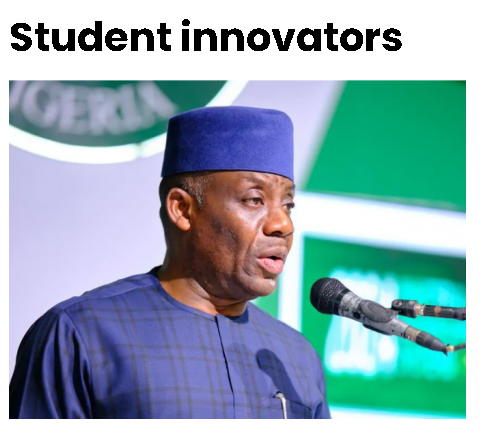
The Federal Government has reaffirmed its commitment to strengthening non-formal education as part of efforts to promote job creation, youth empowerment and economic inclusion across Nigeria.
Minister of Education, Dr Tunji Alausa, stated this during a special plenary session at the ongoing Education World Forum in London.
The plenary, which focused on the role of non-formal education and soft skills in improving wellbeing, employability and industry participation in education systems, was moderated by Prince Edward, the Duke of Edinburgh.
According to a statement issued in Abuja by the Minister’s Special Adviser on Media and Communications, Mr Ikharo Attah, Alausa highlighted ongoing reforms under President Bola Tinubu’s administration aimed at expanding vocational training and digital skills development for Nigerian youths.
The minister explained that the government was prioritising flexible learning pathways that combine literacy education, technical training and entrepreneurship development to address unemployment and reduce the number of out-of-school children.
He said the administration remains committed to using non-formal education as a strategic tool for economic growth and social inclusion.
Alausa disclosed that Nigeria has introduced several informal education programmes targeting out-of-school children, youths, adults and vulnerable groups in order to bridge literacy gaps and improve access to economic opportunities.
According to him, the government developed an Accelerated Basic Education Programme designed to help out-of-school children quickly acquire foundational education and transition into productive livelihoods.
“We have created a separate curriculum for them called the Accelerated Basic Education Programme, which ties them to what they should be learning in school,” he said.
The minister further stated that the Federal Government has intensified Technical and Vocational Education and Training (TVET) programmes by offering tuition-free vocational training, stipends and start-up support to participants.
He added that the National Policy on Skills Development promotes hands-on learning, digital literacy and vocational education for youths and adults outside the conventional school system.
Alausa also noted that mass literacy, adult education and non-formal learning initiatives are currently being implemented nationwide to support functional literacy and continuing education.
He revealed that efforts are ongoing to integrate the Almajiri education system with basic education and vocational skills training in order to improve social inclusion and reduce educational inequality.
“We have infused entrepreneurial training across learning levels to equip learners with innovation and business skills needed for self-reliance,” the minister said.
He added that the government is also expanding digital technology training to prepare Nigerian youths with future-ready skills needed in a rapidly evolving global economy.
Alausa commended Prince Edward for his visit to Nigeria in November 2025 and reaffirmed Nigeria’s continued participation in the Duke of Edinburgh’s International Award Foundation.
Other participants at the session included Ontario’s Minister of Education, Paul Calandra; the Secretary of State for Education of Rio Grande do Sul, Brazil, Raquel Teixeira; and International Youth Representative of the Duke of Edinburgh International Award Foundation, Andrea Chakma.