

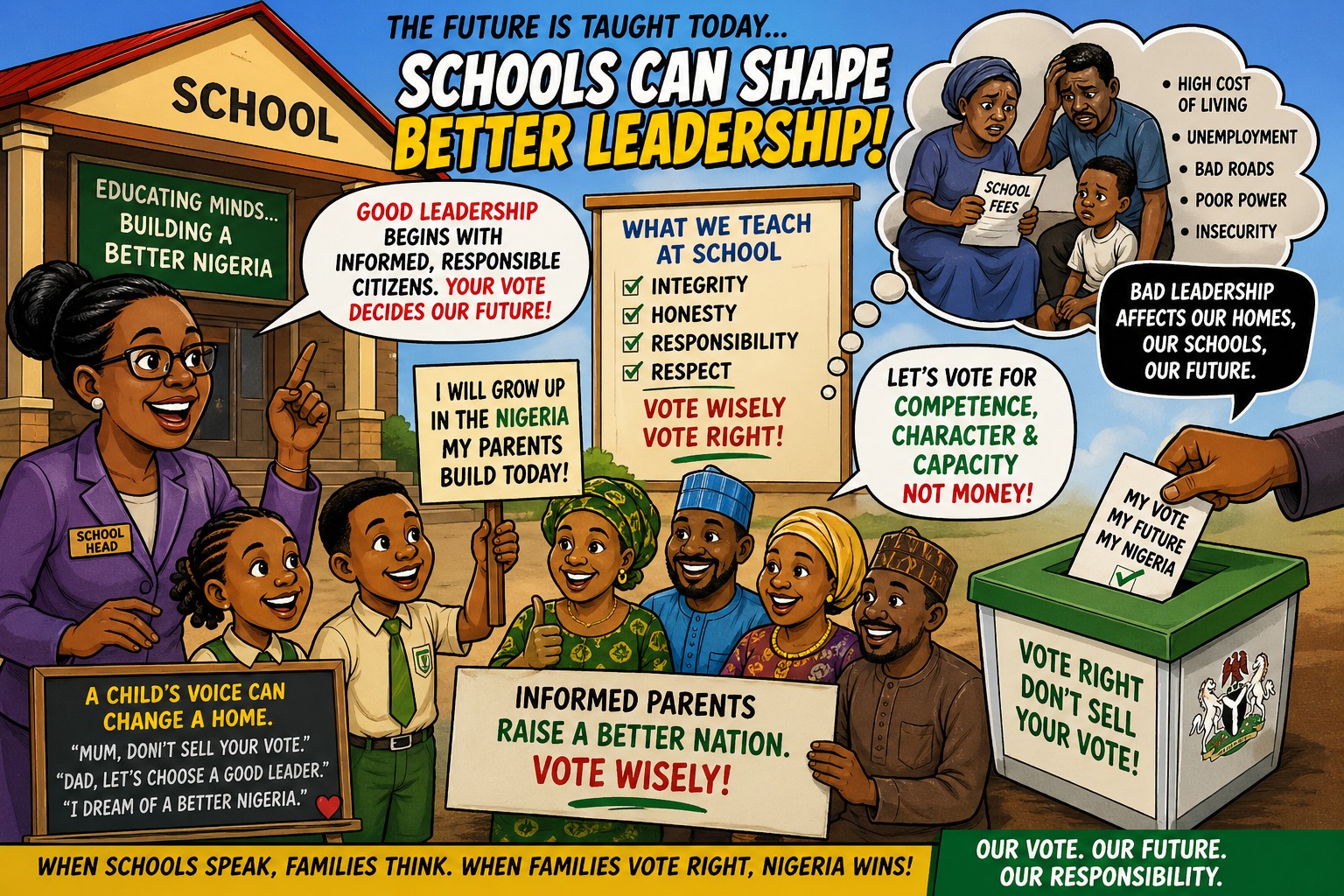
In every election season, politicians often focus on markets, motor parks, religious centres, and town halls. Yet one of the most powerful spaces in Nigeria is often ignored—the school.
Across the country, millions of children walk into classrooms daily carrying more than books and lunch packs. Many carry the silent burdens of poor leadership. They come from homes where parents struggle to pay school fees because salaries are delayed, businesses are weak, inflation is high, roads are bad, insecurity limits movement, and opportunities are shrinking. Children may not vote, but they live with the consequences of those who do.
This is why schools hold a quiet but enormous influence in shaping Nigeria’s future leadership.
The 2027 election offers the school an opportunity to begin to use this influence. The message of how wrong choices must be told the learners, so they and sing it down their parents conscience.
School proprietors, principals, head teachers, and classroom teachers see firsthand what bad governance does to families. They know the parent who begs for extra time to pay fees because transport costs have doubled. They know the brilliant learner who may drop out because the family income has collapsed. They know the teacher whose salary can barely sustain a household.
No institution is closer to the daily effect of failed leadership than the school system. How come they are always laid back when it comes to advocacy for good governance through the classroom?
Schools are not just centres of learning; they are mirrors of society. When leadership fails, the cracks appear in classrooms first. Yes! The numbers begin to drop, the tuition start failing, and disinterest both on the teachers and the learners sets in
Every school is connected to hundreds or thousands of parents. Multiply that across private and public schools, nursery to university level, and you begin to see the scale of influence.
A single school can educate parents beyond academics. Through PTA meetings, newsletters, school events, open days, SMS broadcasts, and community gatherings, school leaders can send one vital message:
Vote for competence. Vote for integrity. Vote for vision. Do not sell your vote.
This is not partisan politics. It is civic responsibility.
When schools teach mathematics, science, discipline, and morals, they are already shaping society. Teaching electoral responsibility is simply an extension of nation-building.
Imagine the power of learners going home with questions like:
- “Daddy, will you vote for someone honest?”
- “Mummy, please don’t collect money to vote.”
- “Can’t we choose someone who cares about schools?”
Sometimes the strongest political message does not come from a campaign rally—it comes from a child’s voice at the dinner table.
Written by
O Joshua Chuks (AKA Chuks Crystal) the CCO Crystal Education Media, A Teacher Trainer, Youth and Character, a writer, editor and business ideas coach,