

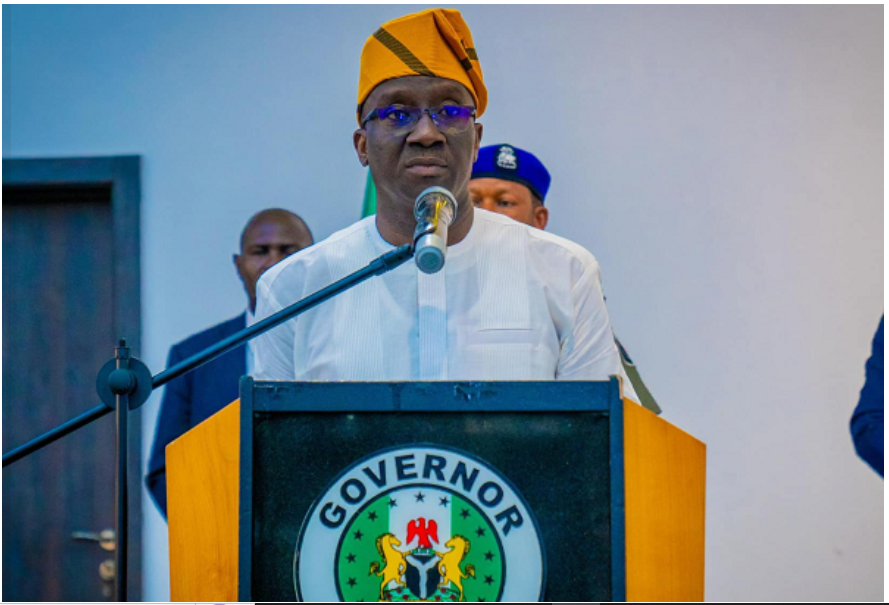
Okpebholo’s Education Reforms Signal Turnaround for Edo’s Tertiary Institutions
Edo State’s education sector is witnessing a significant shift as Governor Monday Okpebholo intensifies efforts to revive tertiary institutions through increased funding, infrastructure investment, and structural reforms.
The latest move came on April 6, 2026, when the governor approved a N2 billion infrastructure grant for Edo University, Iyamho (EUI), alongside an increase in its monthly subvention from N100 million to N250 million. The decision, announced before members of the academic community, underscored the administration’s commitment to strengthening teaching, research, and institutional capacity.
The intervention forms part of a broader education reform agenda focused on restoring financial stability and rebuilding confidence in the state’s higher education system. Observers say the approach marks a departure from previous years, when several institutions grappled with funding shortfalls and administrative challenges.
Ambrose Alli University (AAU), Ekpoma, serves as a key example of that earlier decline. Once regarded as a leading state-owned university, AAU experienced severe setbacks following a drastic reduction in its monthly subvention from N270 million to N41 million under the previous administration. The impact was far-reaching, affecting staff salaries, accreditation of academic programmes, and the overall learning environment.
Students faced disrupted academic calendars, while staff morale declined amid unpaid and irregular wages. Concerns also emerged over administrative decisions that stakeholders feared could weaken the institution’s structure.
Upon assuming office in late 2024, Governor Okpebholo moved to reverse the trend by increasing AAU’s monthly subvention to N500 million. The intervention brought immediate relief, enabling regular salary payments, reinstatement of academic staff, and a return to more stable academic activities.
Longstanding student-related issues were also addressed, particularly in the medical college, where delayed inductions had stalled graduates’ professional progress. With the backlog cleared, confidence in the institution has gradually improved.
Reforms extended beyond funding. A new governing council was inaugurated to strengthen oversight and ensure accountability, while external support, including a N1.2 billion grant from OPay, provided financial assistance to indigent students across the state’s tertiary institutions.
At Edo University, Iyamho, the government adopted a phased funding strategy, beginning with the restoration of its N100 million subvention before increasing it to N250 million. The newly approved N2 billion infrastructure grant is expected to enhance facilities and support long-term growth.
These combined measures reflect a consistent policy direction anchored on increased funding, improved governance, and sustainable development. Within the framework of the state’s SHINE Agenda, education has emerged as a central pillar, with budgetary commitments aligned to long-term goals.
Stakeholders note that the reforms are already yielding visible results. Students are experiencing more stable academic calendars, staff are benefiting from improved working conditions, and institutions are gradually regaining their footing.
While challenges remain, the trajectory points toward recovery. Analysts say the sustainability of these gains will depend on continued investment, effective oversight, and policy consistency.
For now, Edo’s tertiary education system appears to be moving from a period of strain to one of cautious renewal, with ongoing reforms laying the groundwork for a more stable and competitive future.